
Franklin Previous Residents by Historical Era
The best source depends on both date and question. Recorded instruments establish the ownership trail. Regional reverse directories and censuses can supply dated occupant evidence, while plats and local collections reconnect an older legal description to the modern landscape.
| Source | Documented span | Where to use it | What it can show |
|---|---|---|---|
| Deeds | 1835 to present; search keys change in 1948 and 1962 | Milwaukee County Register of Deeds | Parties, transfers, instrument and legal description |
| Reverse-address directories | 1921 to present in the regional run | Milwaukee Public Library | Dated listings arranged by address |
| Milwaukee directories | 1847 to present, with Franklin coverage varying | Milwaukee Public Library | Name, address, and other printed household clues |
| Federal census | Public schedules through 1950 under the 72-year rule | NARA and genealogy/library access | Households as recorded in an enumeration |
| Township plat | 1876 landscape | Wisconsin Historical Society and Franklin Historical Society context | Owners, roads, buildings, schools, churches, and section lines |
| Permit records | Modern city files; exact availability varies | Franklin Inspection Services | Work, applications, inspections, and certificates if public |
For recent decades, start with the current tax key and deed chain. For a twentieth-century occupant, add the address directory. For a nineteenth-century property, legal descriptions, plats, deed-book keys, newspapers, churches, and historical repositories matter more than a modern street number.
Start Previous-Resident Research with the Franklin Tax Key
Standardize the address through USPS, then use the Franklin Assessor page to reach Real Property Data. Record the property address, tax key, and the date viewed. Compare the Franklin GIS outline with Milwaukee County's parcel service and copy the legal description from the proper official record.
The tax key is a bridge, not proof that parcel geometry has always been the same. County metadata says cadastral polygons are updated bimonthly from recorded documents and tax-listing changes. A split, merger, subdivision, road change, or outlot may break a simple address chain. Save each parcel identity before moving backward.
Owner and occupant are different roles. The current assessment and deed evidence starts the title chain. It does not establish all previous residents, family members, or other occupants of the building.
Walk Milwaukee County Deeds Backward
The deed chain starts with the present owner shown by the assessment record and uses each recorded transfer to identify the preceding party. Preserve execution and recording dates separately, because the signed event and county recording can occur on different dates.
- Save the current tax key and legal description from the Franklin property sources.
- Search the current owner as grantee through the Register of Deeds route and identify the acquisition deed.
- Record grantor, grantee, instrument type, document number or book/page, dates, and the legal description exactly.
- Search that grantor as the grantee in the prior acquisition, checking tract and plat keys when names are ambiguous.
- Repeat until the modern index no longer reaches the needed date, then carry document, book/page, plat, and legal-description clues to the counter or historical appointment.
- Grantor and grantee
- The grantor conveys an interest; the grantee receives it. Walking backward usually means finding how each seller previously received title.
- Chain of title
- The connected sequence of recorded interests affecting the same property.
- Legal description
- The parcel description used in land records. It often survives when a street number or road name changes.
Why a Pre-1948 Franklin Deed Can Hide
The Milwaukee County Register of Deeds reports deeds from April 1, 1948 forward searchable by grantor, grantee, tract, or document number. Earlier deeds, from 1835 through March 31, 1948, require document number or book/page. All recordings are available with modern search keys from 1962 forward. Plat searching also changes: material through June 1991 requires document number or plat book/page, while July 1991 forward uses modern keys.
An empty name query is therefore a key problem until proven otherwise. The Tapestry instructions warn that complex searches can fail and recommend simpler input first. Use an older index, known document clue, subdivision plat, legal description, or staff-guided route instead of concluding that the transfer never existed.
The Milwaukee County real-estate records page explains the official access choices for previous-resident property work.
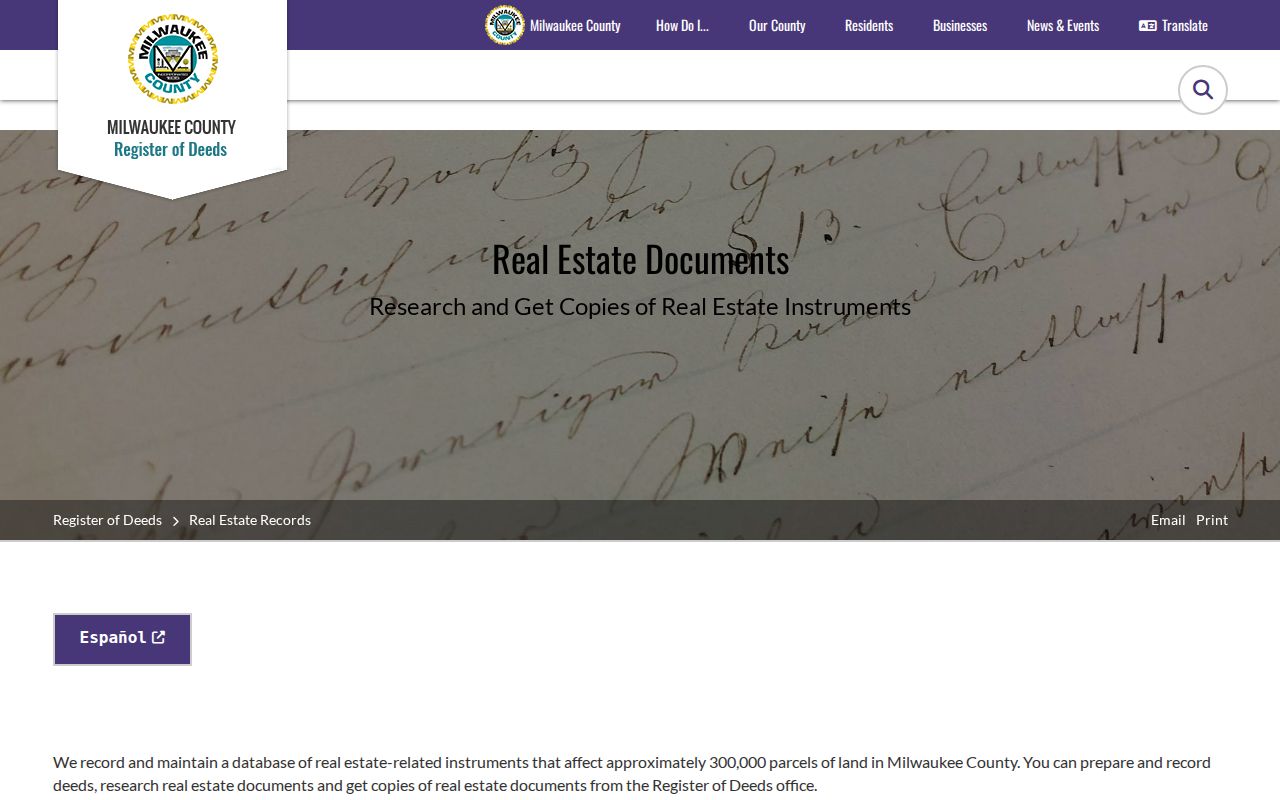
The displayed county route leads to Tapestry as well as counter and mail instructions. Tapestry charges $6.95 per search and $1.50 for the first printed page plus $1 for each additional page; it cannot certify a copy.
Franklin Deed Research Beyond the Web Portal
The Register of Deeds counter is at 901 N. 9th Street, Room 103, Milwaukee, WI 53233, open weekdays from 8:00 a.m. to 4:00 p.m. The general number is (414) 278-4021, and precise quote or search questions go to (414) 278-4001. Historical ownership succession requires an appointment. Staff can orient a researcher to records and indexes but will not perform the entire history.
A mailed request should identify document type or number when known, full name, property address, phone, payment, and whether certification is required. County-listed charges are $2 for the first page and $1 for each additional page, $10 for a search without a document number, and $1 for certification. The card charge is $2.50 or 3 percent, whichever is greater. Confirm costs before sending payment.
These routes make previous residents research possible even when a browser search fails. A public-records channel may obtain county-held material, while Milwaukee Public Library, Wisconsin Historical Society, and Franklin Historical Society supply finding aids and local context rather than certified title evidence.
Pair Franklin Address Directories with Census Years
Once the deed chain produces a surname and approximate years, a reverse directory can test who was printed at the address. Milwaukee Public Library has Milwaukee city directories beginning in 1847 and reverse-address lookup beginning in 1921, but this is a regional collection rather than a guaranteed Franklin-only run. The Franklin city directory guide covers the shelf and how entries work.
- Choose a directory edition near a recorded transfer and search the address exactly as it appeared in that period.
- Record the edition year, page, printed occupant, street spelling, and any cross-reference without modernizing the entry.
- Select the closest publicly released federal census year and locate the correct jurisdiction or enumeration district.
- Compare the household with the deed party, but keep ownership and occupancy as separate findings.
- Test the relationship with another dated source, such as probate, a vital record, newspaper, church record, school item, or the next directory edition.
A census household is evidence for its enumeration date, not the whole decade. A directory is also a publication snapshot. Pairing them can narrow move-in and move-out periods, but only the dated record itself supports the conclusion.
Franklin Township Changes the Backward Trail
Franklin's area was surveyed in the early 1830s, became a civil town in 1839, was organized as a township in 1841, and incorporated as a city in 1956. Previous residents before incorporation may appear under Franklin Township, a section-town-range description, St. Martins, an old road, a farm name, or a subdivision rather than the modern city address.
The 1876 Franklin Township plat records ownership and built geography, including roads, railroads, buildings, schools, cemeteries, churches, streams, and section lines. It can suggest an owner or location to test in the deed books. It cannot replace the recorded conveyance. Milwaukee's 1930 street-number conversion guide is tempting but applies to Milwaukee city, not automatically to Franklin.
When an address goes silent, search the owner name, legal description, lot and block, section-town-range, nearby parcels, and name variants such as St. Martins and Colby Road. Carry the source's original jurisdiction and spelling in the research log.
Colby Road Farms Offer a Franklin House-History Clue
Franklin Historical Society material identifies Fred and Marie Ludwig farm locations at 8520 S. 68th Street, described with the older Colby Road name, and at 7979 Colby Road, with a story extending from 1875. This is a concrete example of why previous residents research should preserve both a present address and historic road wording.
A society story creates a hypothesis: a family name, site, structure, and approximate period. Test that hypothesis against the 1876 plat, county deeds, directory editions, probate, vital records, newspapers, churches, and schools. The society's preserved log cabin, schoolhouse, town hall and general store, chapel, smokehouse, and barn likewise provide building names that may search better than a modern occupant.
Local memory adds meaning, while official deeds establish the property interest. Label each conclusion by source so a preservation narrative is never mistaken for a complete ownership record.
Use Probate and Vital Records as Corroboration
When an owner dies or property passes through an estate, Milwaukee County Probate Court may connect a decedent, representative, parcel reference, inventory, and transfer period. WCCA is only an index for court matters; underlying files must be requested from the courthouse. Older probate material may require the Probate Court counter, Room 207, or a mail route with a self-addressed stamped envelope. Probate can be reached at (414) 278-4452.
Vital certificates are restricted under Wisconsin law and are not open name-search directories. Milwaukee County Register of Deeds and Wisconsin DHS require the applicable form, identification, fee, and proof of direct and tangible interest for certified copies. Historical indexes and genealogy routes through the Wisconsin Historical Society can instead provide leads appropriate to their coverage.
Use an obituary, probate record, or certificate to test a relationship or endpoint already suggested by deeds and directories. Do not use a same-name index result alone to merge two people into one property history.
What Franklin Previous Residents Evidence Proves
A careful backward file separates four findings: who held a recorded interest, who appeared at the address in a dated directory, who was enumerated in a census household, and who appeared in a later estate or vital record. These may overlap, but they are not interchangeable. Record the source, date, jurisdiction, exact name and address form, and retrieval path for every entry.
No official Franklin-only online reverse directory or complete historic-owner index was located in the reviewed research. The documented chain is Franklin assessor and GIS data, Milwaukee County deeds and plats, Milwaukee Public Library's regional directories, and Wisconsin Historical Society or Franklin Historical Society materials. Permit files can add a building event, while newspapers, churches, schools, and CountyCat yearbooks may help confirm a family timeline.
Lawful personal use. Trace previous residents for house history, genealogy, estate work, or personal curiosity. Never use a historical lead to track, expose, threaten, or harass a living person, and respect protected addresses and restricted records.